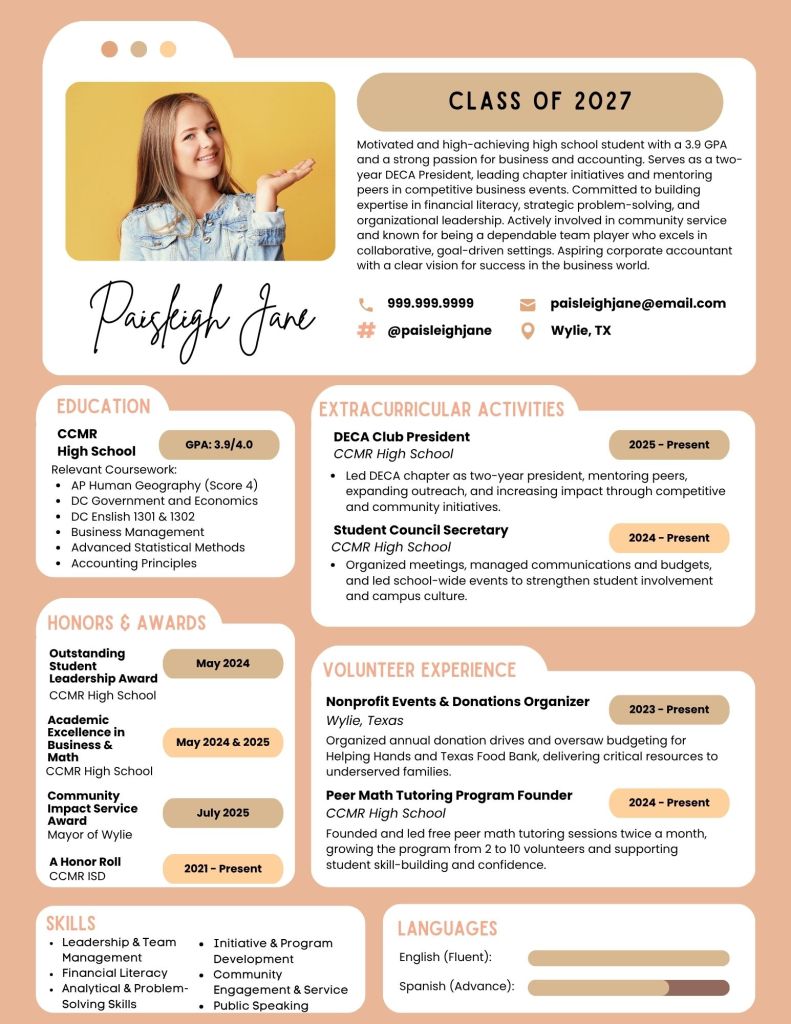
HIGH SCHOOL RESUME GUIDE
Build a Resume That Opens Doors to College, Scholarships, and Your Future
Stand Out With a Professional Resume That Tells Your Story
Creating a high school resume can feel overwhelming, but it doesn't have to be. This comprehensive guide walks you through every step—from formatting and sections to real examples and expert tips. Whether you're applying to colleges, competing for scholarships, or seeking summer programs, you'll discover exactly what admissions officers and employers want to see.
Source: National Association for College Admission Counseling (NACAC) and College Board research data
Quick Overview
Why Every High School Student Needs a Resume
A resume isn't just for job applications—it's your personal marketing tool that tells your story and helps you stand out in college admissions, scholarship competitions, and recommendation letters.
Track Your Growth
Document your four-year journey and ensure you don't forget important achievements when application deadlines approach.
Support Recommenders
Empower teachers and counselors to write stronger, more specific letters by providing them with your comprehensive resume.
Identify Gaps
Creating a resume early helps you recognize areas for growth and plan meaningful activities for future involvement.
Multiple Applications
Use your resume for college apps, scholarships, internships, summer programs, and part-time jobs throughout high school.
💪 Power Your Resume with Strong Action Verbs
Transform weak descriptions into powerful statements by starting each bullet point with an impactful action verb. Choose words that demonstrate leadership, initiative, and results.
| 👥 Leadership | 🏆 Achievement | 💬 Communication | 🎨 Creative | 📊 Organization | 🔬 Research |
|---|---|---|---|---|---|
| Led Directed Coordinated Managed Supervised Mentored Coached Guided Chaired Oversaw |
Achieved Improved Increased Exceeded Earned Won Accomplished Attained Surpassed Advanced |
Presented Communicated Advocated Collaborated Negotiated Facilitated Persuaded Articulated Conveyed Promoted |
Created Founded Designed Developed Launched Initiated Established Pioneered Invented Conceptualized |
Organized Planned Arranged Scheduled Streamlined Optimized Systematized Structured Prioritized Maintained |
Researched Analyzed Investigated Evaluated Examined Assessed Studied Explored Surveyed Calculated |
Strong Resume Examples
Learn from real examples of effective high school resumes. Each example demonstrates different strengths and approaches—click any card to view the full annotated resume.
Arts-Focused Student
Strong academic foundation paired with deep commitment to performing arts. Shows sustained leadership in drama, choir, and visual arts.
Community Service Leader
Founded own initiative and demonstrates entrepreneurial spirit. Exceptional use of quantified achievements showing measurable community impact.
Well-Rounded Student
Balances academics, arts, athletics, and work experience. Demonstrates long-term commitment and progression to leadership roles.
STEM-Focused Student
Clear STEM pathway with research experience and technical skills. Shows intellectual curiosity beyond classroom through independent projects.
Arts-Focused Student with Strong Academic Foundation
- Performed lead roles in 6 major productions including Our Town and The Crucible
- Directed one-act play festival featuring 4 student-written pieces; mentored 12 underclassmen actors
- Organized fundraising events that raised $4,500 for new stage equipment and costumes
- Coordinated monthly art workshops for middle school students; taught basic painting and drawing techniques
- Curated annual student art exhibition displaying work from 45+ student artists
- Performed as soprano section leader; selected for All-State Choir two consecutive years
- Assisted with summer drama camps for children ages 6-12; helped 60+ students develop confidence and performance skills
- Created lesson plans and led warm-up activities for groups of 15-20 children
Key Takeaways from This Example:
- Clear narrative: Demonstrates consistent passion for performing arts throughout high school
- Leadership progression: Shows growth from member to lead roles and directing position
- Quantified impact: Uses specific numbers (6 productions, $4,500 raised, 60+ students taught)
- External validation: Awards and recognitions from competitive programs strengthen credibility
Community Service Leader with Initiative
- Founded community program providing free books to underserved elementary schools
- Organized 8 book drives collecting 3,200+ books distributed to 5 neighborhood schools
- Recruited and managed team of 25 student volunteers for sorting and delivery logistics
- Secured $2,000 in funding from local businesses and community organizations
- Represented class of 350+ students in monthly student council meetings
- Advocated for improved cafeteria options; successfully added 3 healthier meal choices
- Coordinated annual food drive raising 1,800 pounds of food for Greater Chicago Food Bank
- Mentored 3 middle school students weekly; provided academic support and college planning guidance
- Helped mentees improve average grades by one letter grade over school year
- Supervised group of 15 children ages 7-10 during daily activities and field trips
- Developed and led educational games promoting teamwork and problem-solving skills
- Maintained safe environment; recognized by supervisor for responsible leadership
Key Takeaways from This Example:
- Initiative and innovation: Founded own program showing entrepreneurial spirit
- Measurable impact: Every activity includes specific numbers demonstrating reach and results
- Cohesive story: All experiences support theme of community service and youth development
- Professional experience: Summer job complements volunteer work and shows reliability
Well-Rounded Student with Varied Interests
- Led French horn section for two years; mentored 5 underclassmen in proper technique and musicianship
- Performed in regional competitions earning superior ratings; participated in community parades and holiday concerts
- Participated in service projects including tutoring program and school supply drive
- Contributed 40+ volunteer hours supporting community initiatives
- Competed as varsity team member; demonstrated teamwork and dedication through two seasons
- Provided excellent customer service in fast-paced coffee shop environment serving 200+ customers daily
- Maintained organized inventory and efficiently restocked supplies during peak hours
- Trained 2 new employees on register operations and drink preparation
Key Takeaways from This Example:
- Multi-year commitment: Shows sustained involvement in band throughout high school
- Leadership roles: Section leader position demonstrates trust and responsibility
- Balanced profile: Combines arts, academics, athletics, and work experience
- Professional format: Clean sections with clear dates and descriptions
STEM-Focused Student with Research Experience
- Conducted original research on using machine learning to predict wildfire risk under mentorship of Stanford University professor
- Presented findings at Bay Area Science Fair; advanced to California State Science Fair
- Developed mobile app for tracking personal carbon footprint using React Native and Firebase
- Created website for local environmental nonprofit; increased online donations by 25%
- Led 12-member team in designing and programming competition robot for FIRST Robotics Competition
- Secured $3,000 in sponsorships from local tech companies to fund materials and competition fees
- Provided free tutoring in algebra and geometry to underclassmen twice weekly
- Helped 8 students raise math grades by average of one letter grade
Tools & Platforms: GitHub, Visual Studio Code, Arduino, MATLAB
Key Takeaways from This Example:
- Cohesive narrative: All activities support a clear STEM interest and career path
- Quantified impact: Uses specific numbers ($3,000 raised, 25% increase, 8 students helped)
- Technical skills section: Relevant for STEM programs and internships
- Research experience: Shows intellectual curiosity beyond the classroom
What Should You Include in Your High School Resume?
Academic Information
- • High school name & graduation year
- • GPA and class rank
- • Test scores (SAT/ACT)
- • Relevant coursework (AP, IB, dual credit)
Activities & Leadership
- • Extracurricular activities
- • Sports and clubs
- • Leadership positions
- • Awards and honors
Experience & Skills
- �� Work history and internships
- • Community service
- • Volunteer work
- • Special skills or certifications
🚫 Resume "Don'ts" Gallery
Learn from these common mistakes. We've seen these errors countless times—make sure they're not on your resume!
Houston, TX | (713) 555-0142 | partygirl2024@email.com
• Attended meetings
• Helped with events
• Was involved in school activities
Common Resume Mistakes to Avoid
Understanding what not to do is just as important as knowing best practices. These common errors can weaken even the strongest credentials.
| Mistake to Avoid | Better Approach |
|---|---|
| Using an unprofessional email address like partygirl2024@email.com | Create a simple email with your name: firstname.lastname@email.com |
| Listing activities without any description of your role or impact | Include 1-2 bullet points explaining your contributions and achievements |
| Including middle school activities or outdated achievements | Focus only on high school experiences unless middle school activities continued into 9th grade |
| Using tiny fonts or narrow margins to fit everything on one page | Use readable 11-12pt font and expand to two pages if needed for strong juniors/seniors |
| Exaggerating roles or fabricating experiences | Be honest and accurate; colleges verify information and value authenticity |
| Forgetting to update dates and current activities each semester | Review and update your resume at least twice per year with new accomplishments |
How to Tailor Your Resume for Different Purposes
Maintain a master resume with all experiences, then create tailored versions that highlight the most relevant qualifications for each opportunity.
🎓 For College Applications
▼Emphasize academic achievements, intellectual curiosity, and activities that show depth of commitment rather than breadth. Admissions officers want to see sustained involvement and leadership over several years.
Highlight experiences that connect to your intended major or demonstrate qualities the college values. Research each college's mission and culture to understand what they're looking for in students.
💰 For Scholarship Applications
▶Read the scholarship criteria carefully and emphasize experiences that match their priorities. A community service scholarship wants to see your volunteer work featured prominently, while a leadership scholarship should highlight your officer positions.
Include specific metrics that demonstrate impact—funds raised, hours volunteered, people served, or programs created. Scholarship committees use these concrete details to compare candidates.
🔬 For Summer Programs and Internships
▼Highlight relevant coursework, skills, and any prior experience in the program's focus area. If you're applying to a research program, emphasize your science courses and any research or STEM activities.
Include a brief objective statement at the top of your resume explaining your interest in the specific program and what you hope to gain from the experience.
💼 For Part-Time Jobs
▶Focus on transferable skills like responsibility, customer service, time management, and reliability. Employers want to know you'll show up on time, work well with others, and represent their business professionally.
Previous work experience, volunteer roles with responsibility, and activities showing commitment are most relevant. You can de-emphasize academic honors that don't relate to workplace skills.
Frequently Asked Questions
Students and families often have similar questions about creating effective high school resumes.
What should a high school freshman include on a resume?
▼Freshmen should start with basic sections including contact information, education with current courses, any middle school activities continuing into high school, and initial volunteer experiences or part-time work. Your resume will naturally be shorter at this stage, which is completely normal and expected. Focus on getting the structure right and updating it regularly as you gain more experiences throughout high school.
How long should a high school student's resume be?
▼Most high school resumes should be one page for freshmen and sophomores, and can extend to two pages for juniors and seniors with significant experience. Quality matters more than length—a strong one-page resume is better than a padded two-page document. Never shrink fonts below 11pt or reduce margins to squeeze everything onto one page, as readability is essential.
Should I include my GPA on my resume?
▶Include your GPA if it strengthens your application—typically 3.5 or higher on a 4.0 scale, or above your school's average. Specify whether it's weighted or unweighted, as admissions offices need this context. If your GPA doesn't reflect your abilities due to a difficult freshman year or personal circumstances, you can omit it from your resume and address it elsewhere in your applications.
How often should I update my high school resume?
▼Update your resume at least twice per year—at the end of each semester or during winter and summer breaks. Regular updates help you remember specific details, achievements, and dates while they're still fresh. Set a recurring reminder to review and add new activities, leadership positions, honors, or work experiences. Many students find that updating after major events like competitions, performances, or award ceremonies helps capture important accomplishments that might otherwise be forgotten.
Ready to Build Your Candidacy?
A strong resume is just one piece of building your candidacy for college and career success. Schedule a personalized planning session to create a comprehensive strategy that showcases your strengths, identifies growth opportunities, and positions you for post-secondary achievement.
Schedule a Planning Session to Build Candidacy